2026 · Case study
← Back to workWeekend family experiment
Bonsall Bounce
- Role
- Designer + builder
- Team
- Family of 4
- Timeline
- Weekends, 2026
- Tools
- Lovable, Figma
Problem
Bonsall is a small town, population under 4,000, with a reputation for being out of the way. In reality it's full of higher-end families with a lot of young kids, exactly the demographic that throws birthday parties every weekend.
Trying to get a bounce house delivered here is dicey. Most rental companies won't drive out this far, the ones that will tack on distance fees, and the units that show up are often the loud, primary-colored castles that clash with the styled backyard parties these families actually want.
The usual experience: you call a number, and the bounce house arrives late, dirty, and you're not sure it's going to hold up through the party. So the idea was to invest in a house that was reasonably priced, versatile, and photogenic, first for our own family, then test the market to see if we could rent it out on the weekends.
Challenge and Research
The goal was simple: cover the cost of the first bounce house, and use what we learned to decide whether to invest in a second. That meant treating this like a real market test, not just a family purchase.
I started posting AI-generated images on Instagram to gauge interest and shape the brand look before spending on photography. The feed pulled in early feedback and DMs, which gave us a first read on which styles and price points resonated.
From there, I ran a small focus group with 10 local moms to test the booking flow end-to-end. The hypothesis: if we kept the base rental price reasonable, families would happily layer on reasonable add-ons (extra time, tables, popcorn, etc.), making the unit economics work without pricing anyone out.
Synthesis
My research surfaced three patterns that reshaped the offer and the flow:
- Tight budgets are the norm. Families want a clear base price and small, honest add-ons, not a quote-by-phone dance.
- Parties aren't planned far in advance. Most booking interest lands inside a 1-2 week window, so the site has to make short-notice availability feel obvious and safe.
- "Wet/dry" is misleading. Despite the marketing category, the unit doesn't actually hold up well in water, so I reframed listings and add-ons around dry-play use.
Design Recommendations
The brand had to feel like a styled shoot, not a carnival, photogenic, calm, and mom-friendly. Every design decision laddered back to that one promise: "Everyone has fun, including mom."
Voice & positioning
- Mom-centric, calm-over-chaos angle, not kid-hype.
- Four pillars: Family-Run & Local · Non-Toxic & Safe · Affordable for All · Mom Has Fun Too.
- Promise: "photogenic, clean, adds to the calm of your celebration."
Palette
Typography
- Wordmark: soft humanist display, friendly, slightly retro. "Bonsall" in forest, "Bounce" with the two o's replaced by stacked coral and mustard dots.
- Body: clean sans, casual not corporate, high legibility on mobile.
UI & layout moves
- Hazy, sun-flared hero photo with the wordmark centered, editorial, not e-commerce.
- Pill-shaped buttons: solid forest primary, outlined secondary.
- Icon-led nav labels (calendar, cart, camera, star) to keep tone casual.
- Section rhythm: hero → 4 value cards → packages → extras.
- Companion mark: coral castle silhouette for favicons and small placements.
Visual motifs
Pastel balloon arches, white bounce houses, wooden cross-back chairs, florals, and overexposed light, mom-blog / wedding-photographer grammar, deliberately borrowed to earn trust with the target host.
Takeaways & Next Steps
What we are learning
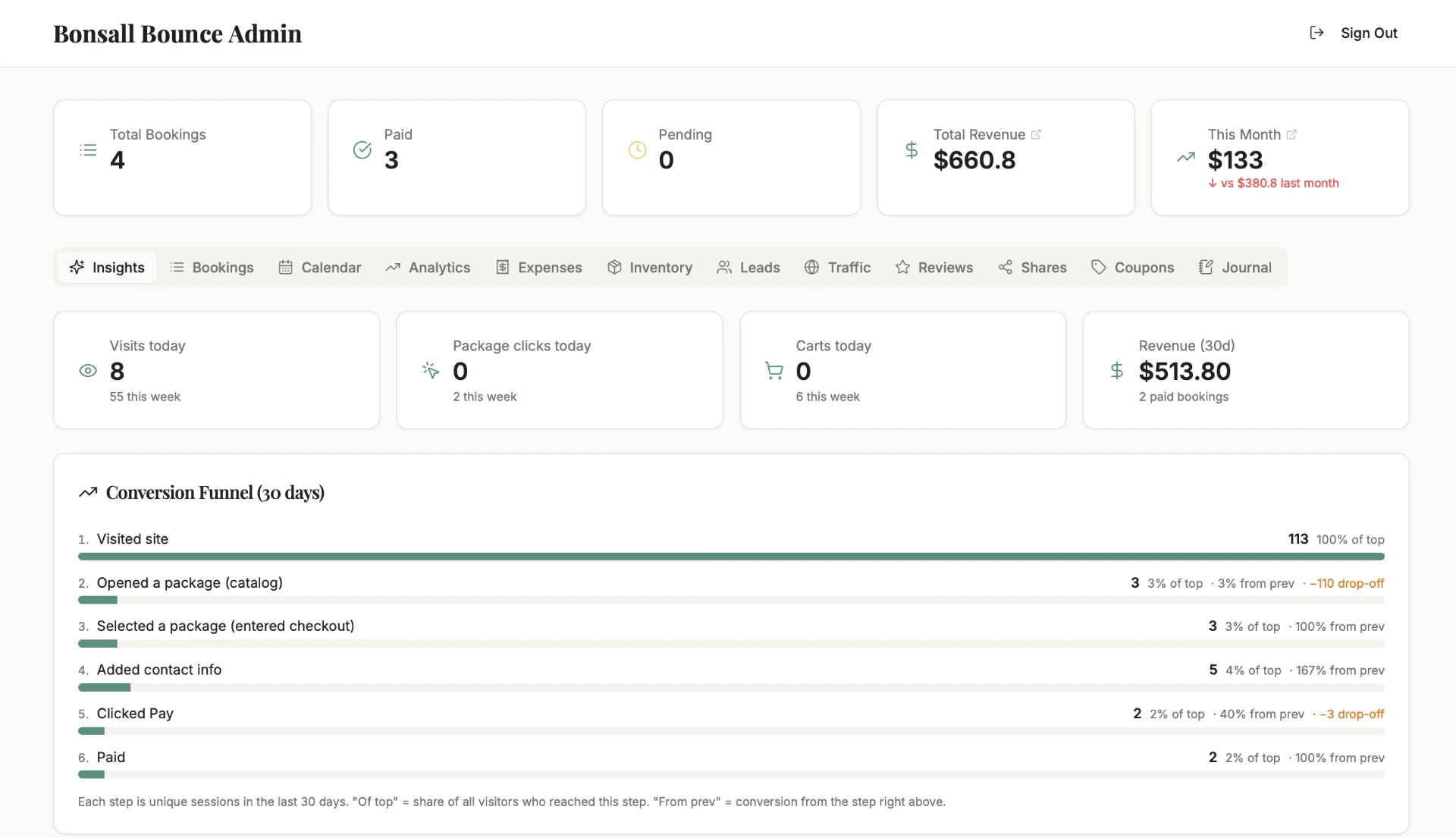
We have had a few bookings since launch, enough to see real patterns instead of guesses. Lifetime revenue sits at $660.80 across four bookings, with $513.80 of that landing in the last 30 days from two paid bookings. Small numbers, but they are moving, and each one is teaching us something about how families in Bonsall actually book.
Paid visibility moves the needle here more than we expected. We pulled a small ad in the local dance recital program, the only spend we could comfortably afford, and traffic tanked almost immediately after it ran its course. Bonsall is small enough that a single well-placed, offline touchpoint can carry the funnel for weeks; when it disappears, so does the top of funnel.
The funnel itself is where the work is. Of 113 visitors in the last 30 days, only 3 opened a package, and everyone who did entered checkout. The drop is happening before the catalog, not inside it, which points at the landing page and pricing clarity rather than the booking flow we spent the most time on.
Next steps
- Time the next push to the new park opening. Line up promotions, signage, and a launch weekend around the ribbon cutting so we ride the built-in foot traffic.
- Add more publicly visible offline ads, recital programs, sports rosters, café bulletin boards, anywhere local families already look.
- Adopt-a-Highway sponsorship along a Bonsall road (currently on the waitlist). It's free, gives us a permanent roadside sign, and reinforces the "family-run & local" pillar.
- Flyers at NCAD (North County Academy of Dance), the dance-family audience already converts best.
- School volunteering as a soft channel. I already volunteer and wear branded apparel on campus. Next step is a short, written pitch for PTA / school-event coordinators so Bonsall Bounce becomes the default for fundraisers and end-of-year events.
D-F-V audit
Bonsall Bounce
A desirability, feasibility, viability audit of Bonsall Bounce, applying IDEO's D-F-V framework to a business already in motion, using real customer signal, real build decisions, and real financials.
Desirability
Did people actually want this?
The signal came before the business idea did. At three different parties, I specifically asked where the bounce house had come from, and the answer was never a company. It was a guy with a number who dropped it off for the weekend and picked it up whenever. Drop-off and pickup times were a mystery. The bounce houses often arrived dirty. And in the entire time I've had a 6 and 8 year old, we never once had a bounce house delivered for one of our own parties, despite wanting one.
That gap, no visibility into who's coming, when, or in what condition, is the desirability signal the business is built on. It also produced a specific feature idea: a delivery tracker modeled on a pizza-delivery tracker, so a customer isn't left guessing.
Before spending on inventory, I also ran a small focus group with 10 local moms to test the booking flow end-to-end, and to test a specific pricing hypothesis: that a reasonable base rental price plus small, honest add-ons (extra time, tables, popcorn) would make the unit economics work without pricing anyone out. That research surfaced three things that reshaped the offer: families want a clear base price rather than a phone-quote negotiation, booking interest lands almost entirely inside a 1-2 week window rather than being planned far ahead, and the "wet/dry" category label was actually misleading for this unit, which pushed the positioning toward dry-play use.
Feasibility
Could it be built, given the resources actually available?
Not "do we have engineers," but "do we have anyone." It was just me, not a developer, out of work at the time. The feasibility question became: what can one non-technical, design-trained person actually stand up.
What I decided I could build:
- A booking flow I would personally want to use, with the advantage of being my own target customer.
- A site fast enough to test in the wild (Lovable/Base44), launched before a single bounce house was purchased.
- A liability agreement signed inside the booking flow itself, something I hadn't seen any competitor on our street do.
- A Bonsall-resident discount, to celebrate the town rather than let the business swallow our own weekends.
- Two customer personas, built from myself and my best friend (a version of me with more leisure cash), used to shape the site design decisions.
What I decided about the physical product: pastel and white bounce houses instead of the bright primary-color combinations typical of the category, partly an aesthetic call as a designer, partly practical, dark and saturated colors run hotter in the sun. Used Claude to research makers, custom designs, cleaning, and transport options before ever placing an order.
What I decided about brand, before owning inventory: shirts, hats, and circle magnets ordered, social channels built and active before the first bounce house arrived. Fake it 'til you make it, as a deliberate validation strategy rather than a shortcut.
Naming:
Chose "Bonsall Bounce" over "Bounceall." Bonsall is a town inside San Diego County that maybe 5% of San Diegans have heard of, and putting it in the name was intentional, both to celebrate local customers and, from prior SEO consulting experience, because the alliteration and place-name specificity would rank better than a generic name.
Logo:
Designed the first version myself, with my daughter, sketch plus Claude. Wanted the two Bs to interact visually, a mural/story feel rather than a flat wordmark, and colors that were gender-neutral and Instagram-friendly.
Marketing test result:
One paid print ad (an NCAD recital program placement) produced a measurable drop in traffic, effectively zero. That channel is closed. Facebook activity is the one channel that reliably produces a visible spike, though it's hard to sustain FB content before owning the physical product; AI-generated preview images of the target bounce house were used to post activity in the gap.
Viability
Can the business sustain a real cost structure?
This is the lens I hadn't yet answered in numbers, so it's built as a live model rather than a narrative.
Current dashboard snapshot (lifetime):
| Total bookings | 4 (3 paid) |
| Lifetime revenue | $660.80 |
| This month vs last | $133 vs $380.80 |
| Operating spend (100% deductible) | $421.07 |
| Equipment capex (depreciation-flagged) | $1,515.73 |
The first modeling decision was separating those last two numbers. Lumping $1,936.80 in total expenses together makes the business look worse than its actual unit economics, because $1,515.73 of it is one-time equipment capital, not a recurring cost each booking has to cover.
The break-even framework:
- Contribution margin per booking = price - cash cost per delivery (gas, cleaning, Stripe fees, wear reserve) - labor cost (hours x hourly rate)
- Break-even bookings/month = fixed monthly costs (insurance, subscriptions) / contribution margin per booking
- Payback period = equipment capex / monthly profit at current booking pace
Built as an interactive calculator so the real numbers (insurance premium, actual per-delivery cost, a real hourly rate for my own time) can be dropped in as they're confirmed, rather than estimated once and left stale.
Pricing strategy named:
Current pricing is deliberate penetration pricing, below eventual market rate, aimed at building booking count, reviews, and word-of-mouth fast. The open question this framework forces is not "is this viable at these prices" but "is this viable at these prices for how long," with a specific graduation trigger (a booking count, a review count, or a date) to decide when prices move toward normal.
Add-on economics: cotton candy
The first cotton candy booking is next month, for a party of 20 kids, so this is the first add-on priced with real cost data rather than an estimate. Supplies are planned for 60 servings rather than 20, to cover drops, adults who want some, and mis-makes.
| Cost | Amount |
| Cones (60 servings) | $11 |
| Sugar, prorated (60 of 100 servings @ $60) | $36 |
| Labor (3 hrs, incl. setup) | $75 |
| Machine, amortized | $40 |
| Floor cost per event | $162 |
The machine itself is $400, a one-time purchase, so it only enters the per-event cost once it's amortized across a number of future bookings. Two amortization scenarios were considered: 10 events ($40/event, the conservative case) and 30 events ($13.33/event, the optimistic case). The first booking is priced off the 10-event floor deliberately, it's easier to lower a price customers already accepted than to raise one they didn't expect, and real booking volume over the next few months will show which scenario the add-on actually lands closer to.
Open items still being modeled:
Real per-delivery cash cost, annualized insurance premium, and a labor rate for my own time, husband's time and role in day-to-day operations.